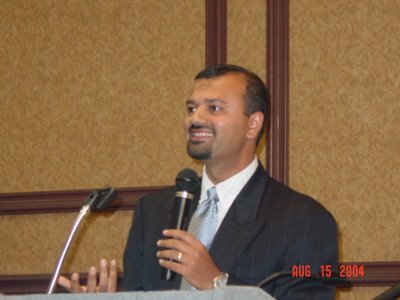
“Thank you for Saving my life”…. He said
Khutba delivered on March 2, 2007:
• As I was thinking last night about what I wanted to speak about today, I had come up with a fairly good topic; but this morning, I heard a story on the radio that I think is important to touch upon and I will save the other one for next time
• One of the reasons why this story appealed to me was because, as you know, I am getting my pilot’s license; so in this one, in the mid 70s, a TWA flight took off from NYC and an American Airlines took off from St. Louis, I think. They were on a collision course and the Air Traffic Contoller, after realizing this, told one of the planes to lower altitude; on the way down, the plane somehow got stuck nose down heading straight for the ground; everything happened in 90 seconds; by asking the pilot to move left and right, the ATC person was able to guide the airplane to a safe landing;
• On this radio station today, they had connected the ATC person and the pilot of the aircraft and his daughter; they had never met and this was the first time they were talking to each other after the incident; what I would like to speak about in this khutba is specifically what the daughter of the pilot said to the ATC person: “thank you for saving my father’s life; because of you he has lived 30 more years, is 82 and has 3 children and 4 grand children”
• I thought this was a very interesting comment and as I began to think about it, I thought about what I would think and say in this situation; Allah mentions in the Qur’an that “every soul shall taste death” and we know from the hadith of our Prophet that there are things that are decided for you when we are in the womb of our mothers, one of which is the time of your death, or put another way, how long you will live; so lets break her statement down, and analyze it from a Muslim perspective
• The first part is when she thanked the ATC person which is a basic instinct that all humans have; that we show appreciation for the good things people do in our lives, sometimes to us directly and other times to us indirectly; and showing gratitude is a good thing to do and can be considered an act of charity; in fact I think one can argue that we, as Muslims, don’t do it enough; sometimes saying thank you for the simple mundane things that people (mothers, fathers, children, wives, and husbands) do go unnoticed and uncomplimented; but when the are done, even if the appreciation is in the form of a smile, it can go a long way and do wonders in a relationship
• Now the second part of what the daughter said to the ATC is what I would like to focus on next: because of you, he has lived 30 more year, is 82 and has 3 children and 4 grand children; would I have said the same thing were I in that situation? Most likely not, because as a Muslim I know that no one person can control my destiny, that is up to Allah; and since the time and place of my death is written for me, then I could never attribute my long life to any one person, no matter what they did for me;
• So even in this situation, where you see a direct cause and effect – ATC did something to avoid plane disaster and saved pilot and 150 other passenger lives, we must know that a higher power is acting on our lives and it wasn’t the act done by the ATC; put another way, even if that plane would have crashed, and all the passengers would have died, the pilot would have lived, would be 82, with 3 children and 4 grand children because that is what was written for him before the time of his birth when he was in his mother’s womb;
• How can I be so sure? Because the Hadith of the Prophet is very clear: On the authority of Abdallah ibn Abbas who said: ‘One day I was behind the Prophet (SA) and he said to me: young man, I shall teach you some words of advice: be mindful of Allah, and Allah will protect you; be mindful of Allah, and you will find Allah in front of you; if you ask, ask of Allah, if you seek help, seek help of Allah; know that if the nation were to gather together to benefit you with anything, it would benefit you only with something Allah had prescribed for you; and if they gathered together to harm you with anything, they would harm you only with something that Allah had already prescribed for you, the pens have been lifted and the pages have dried”
• So if you go to the part of the hadith where the Prophet says: know that if the nation were to gather together to benefit you with anything, it would benefit you only with something Allah had prescribed for you; and if they gathered together to harm you with anything, they would harm you only with something that Allah had already prescribed for you… based on this, I know with certainty that that ATC was not the cause of the man living that day 30 years ago but rather it was Allah who had already written for the pilot how long he would live; that day 30 yrs ago, it was not his time to meet Allah and so he survived;
• Many times in our lives we are faced with situations where it seems that because of your own actions, or of someone else’s actions, you survive death; and colloquially, people say “cheated death” as an expression; sometimes, it is in an accident, other times it is a doctor performing surgery, and yet other times it might be a disease we have and we take medicine for it and seek treatment; As Muslims, however, we need to be clear in understanding that the giver and taker of life is Allah, and Allah alone; many times in the Qur’an, it says “He creates life and creates death, and he has power over all things”
• So the next time we hear of someone being saved, or you save someone, or someone saves you, it is important to thank that person, but at the same time, we should be thankful to Allah, because he allowed that person to be a vehicle for saving us because it was not our time for death; more importantly, we should reflect on the the fact that Allah has given us more time in this world to do good and stay away from evil; in the story I gave earlier about the pilot who survived a near crash, besides having on the radio the reuniting of the ATC and the pilot, which was very touching and heart-warming, I think a better story would have been to find out what the pilot did for the next 30 years of his life; did he use this experience to do good, to become better, or did he just blow it off and did nothing, which would have been a complete waste;
• So as we go through these experiences in our own lives, we should know that all of us, one day will die, that Allah is the creator of life and death, and that this experience should be used as a learning experience that we become better Muslims by;
• On the other side of this thinking, however, is that we begin not to care about life, because it is with Allah anyway; yes, our life and its span is with Allah, but even then, as Muslims, we are encouraged to live our lives to the fullest; a quote by Ali ibn Abi Talib says: “live your life as if you will live forever, and practice your deen as if you will die tomorrow” and in a hadith of the Prophet, he mentions that if a farmer is planting his harvest and the day of judgment arrives, he should continue to plant.
• As such, we should not take the idea that Allah is the creator of life and the creator of death to be a fatalistic message, but rather a message of inspiration; not as a message that no matter what we do, it doesn’t matter in the end because it is all with Allah anyway, but rather, knowing that all matters, including life and death are with Allah, are with Allah, we should go about our lives not afraid of bad consequences when we stand up for justice and truth;
Labels: bellingham, death, khutba, life, monem, salam, speeches